


COMPANY INFORMATION
Financial Capital Strategy (Message from an Executive Officer)

Review of first fiscal year of resilience phase of Medium-Term Management Plan 2030 and quality of profit growth
In fiscal 2025, the first year of Medium- Term Management Plan 2030, which is being advanced as part of the resilience phase, progress on all profit indicators and ROE is tracking ahead of schedule, making for a solid start.
While we were able to reliably take advantage of favorable market conditions in certain respects, growth was supported by more than just a market tailwind. We believe that growth in earnings per share (EPS), which is at a high level compared with our sector peers, is evidence that the Company’s inherent strengths are consistently delivering.
In particular, this evidence is further reinforced by the sustained growth of the Real Estate Agents Segment and the strong increase in rents for existing offices, centered on the Greater Shibuya Area. The Shibuya area exerts a powerful gravitational pull on start-up companies as well as talented young professionals. To hone this regional advantage, the Company has cultivated an ecosystem that creates office demand for the entire area over the medium to long term, through support for start-ups and industry development, which has resulted in an average increase of nearly 15% in office rents in fiscal 2025. We are confident that growth driven by our enhanced capabilities, not dependent solely on the market environment, is steadily building momentum.
In addition, the improvement in earnings power that Tokyu Fudosan Holdings built up in the restructuring phase of the previous medium-term management plan has carried over into the resilience phase as well. Improvements in the profit margin of each business segment directly boosted ROE, and even as the Company reduces financial leverage, growth backed by the quality of earnings is taking hold. While capital gains increased to a level higher than we had forecast, stable profits, such as income gains and management & fee income, are also steadily building up. The expansion of such stable profits directly enhances resilience to market fluctuation risks, and from the perspective of the profit structure, our ability to respond to changes in the external environment, such as rising interest rates and soaring building construction costs, is getting stronger.
On the other hand, we recognize that the current business environment has entered a phase in which the capabilities of management teams are being tested more than ever before. We have not been in inflationary conditions, including rising interest rates, since Japan’s asset price bubble of the late 1980s. Back then, however, the inexorable rise in real estate prices concealed many management issues. This time, we are naturally not depending on appreciating real estate prices, and as building construction costs continue to rise, we believe that differences in corporate earnings will start to clearly emerge over the next several years, depending on how effectively companies utilize the cash they have earned. As someone involved in management, I feel that this is where we earn our keep, but at the same time, we will navigate this transition without becoming complacent.
While consistent inflation brings challenges on the cost side, it also means that the business environment has become one in which we can continuously grow the top line. It is important to view this change as an opportunity and to concentrate the allocation of funds in the Group’s areas of strength, where the prospects of success are higher. Although we are now planning to update to the medium-term management plan, which are scheduled to be announced in 2027, we will maintain the two axes of “pursuing high efficiency and growth potential” and “enhancing resilience to market fluctuations,” while updating the methods of achieving them in response to changes in the operating environment.
Capital allocation and financial strategy for enhancing corporate value
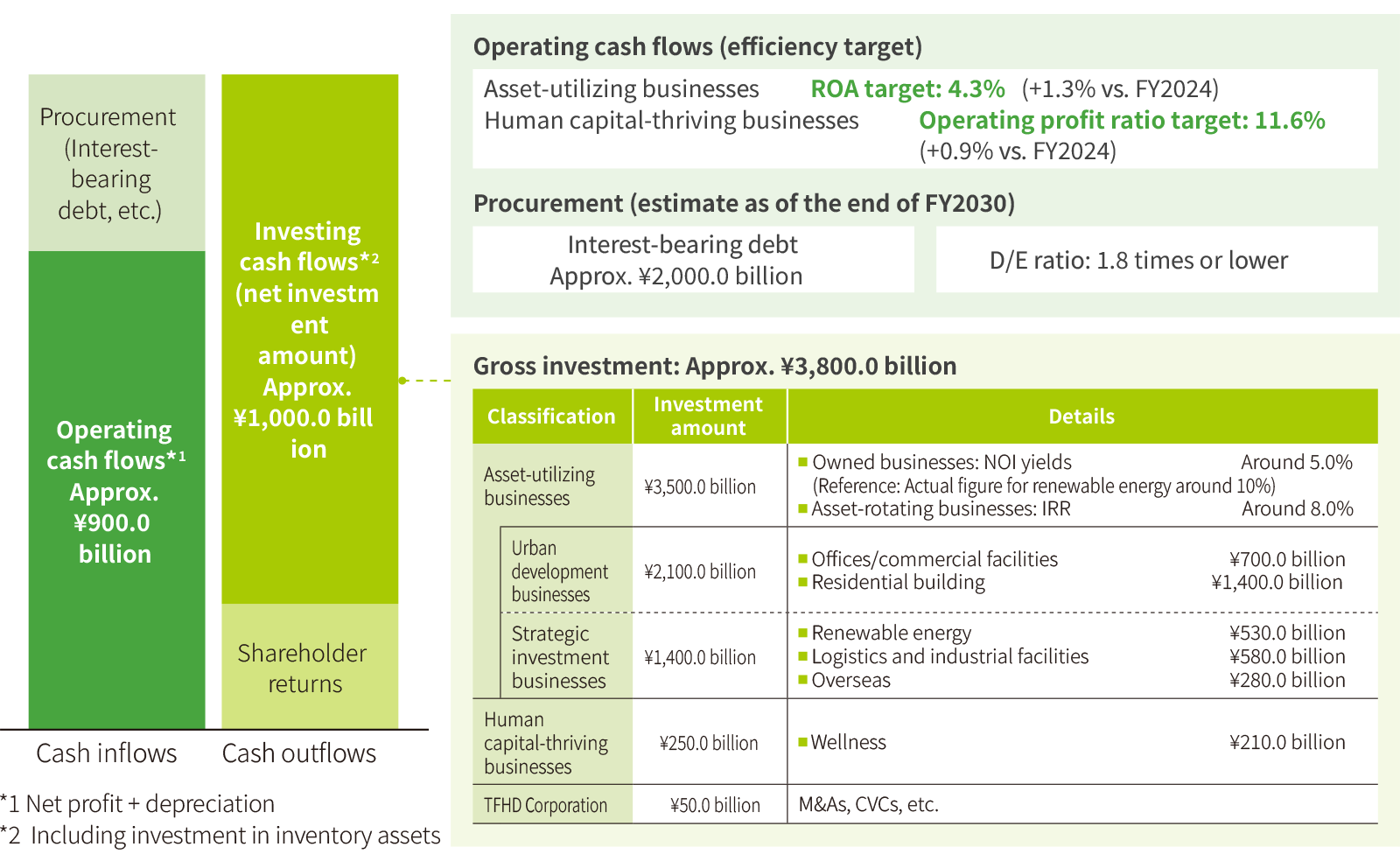
Under the medium-term management plan, we have budgeted for investments of approximately ¥3.8 trillion over the entire period, or around ¥630.0 billion per year on average. In fiscal 2025, in line with this investment plan and while strictly applying the hurdle rates set according to the characteristics of each business segment, the Company executed investments for future growth.
In an economy of rising interest rates, we will review these hurdle rates with the intention of increasing them. That said, an even more important criterion in our investment decisions will be the extent to which we can reliably project growth in cash flows in an inflationary environment. We have not changed our approach to carefully selecting projects that can reliably generate excess returns and making investments that directly lead to greater corporate value. We believe that the accumulation of these disciplined investments will contribute to the sustainable improvement of ROA and ROE.
Amid rising interest rates and building construction costs, from the perspective of improving efficiency, rather than investing in and owning everything ourselves, we will proactively utilize frameworks that incorporate third-party capital from external companies and real estate investors. The Group consists of companies with extensive track records that undertake a wide range of functions in the asset-utilizing businesses and the Property Management and Operation segment. Backed by our strong competitiveness in asset management and property management and operation, in promoting and expanding frameworks that utilize third-party capital, the Group’s strengths make it a partner of choice for external companies.
From the perspective of financial soundness, under our policy of gradually reducing the D/E ratio to 1.8 times or lower by fiscal 2030, we will appropriately control leverage while maintaining financial discipline. Taking into account the rise in interest rates, we expect the cost of equity to also gradually rise. Precisely for this reason, it is essential to continuously keep ROE above the cost of equity. We thus strongly emphasize this in our decisions on capital allocation for investments, shareholder returns, and debt levels.
We also need to keep in mind the possibility that interest rates may rise more than anticipated in the future. Therefore, rather than treating our investment plans and financial indicators as fixed, it is important to flexibly allocate the cash generated from our businesses more nimbly and efficiently. While carefully assessing the balance among growth investments, financial soundness, and shareholder returns, we will carry out optimal capital allocation based on the phase.
In strengthening our funding base, we are moving toward the proactive utilization of ESG financing. Recently, financial institutions and bond investors have become much more interested in ESG financing, and our implementation of ESG financing has expanded our access to financial institutions and investors, which has also led to improvements in our funding terms and conditions. We believe that these efforts not only lower direct funding costs but also serve as an opportunity for a broader range of stakeholders to understand the Group’s initiatives for addressing social and environmental issues, thereby contributing to the enhancement of corporate value over the medium to long term.
Financial value generated by Company-wide policies and human capital management
Our Company-wide policies for environmental management and digital transformation (DX), along with human capital management, are positioned as areas for strategic investments that enhance our competitive advantages and strengthen the future earnings base. I regard these investments as sources of multi-layered value creation that lift the Company’s price-to-earnings (P/E) ratio by reducing the cost of equity and improving the expected growth rate, thereby enhancing corporate value.
In environmental management, Tokyu Fudosan Holdings is promoting the environmental premium, which creates high added value by combining its strengths in environmental advances with the resolution of social issues. To give a specific example, we have introduced GREEN AGENDA for BRANZ in our condominium sales business. This involves formulating a long-term landscape management plan for the greenery planted on the condominium building grounds and creating verdant living environments by nurturing green spaces and biodiversity. This is an initiative where appropriate management of the natural environment enhances landscape preservation and customer satisfaction, leading to improvements in asset value and brand value. In DX, Tokyu Fudosan Holdings is creating value through a transformation of its business model that goes beyond just improvements to operational efficiency. For example, the Tokyu Stay Official Accommodation Rights Resale Service issues hotel accommodation reservation rights as NFTs* and provides a mechanism whereby customers can sell these NFTs on secondary trading markets if they are unable to stay at the hotel. By leveraging DX, we are resolving issues on both sides, such as vacancies arising from last-minute cancellations due to reasons concerning accommodation facilities as well as the lack of refunds for customers on non-cancellable plans when their schedules change.
For the Tokyu Fudosan Holdings Group, which spans a wide range of business fields, human capital is a vital form of management capital that not only underpins the competitiveness of each business segment but also fuses together knowledge across fields. Through personnel placement, development, and investment plans that enable a diverse workforce to perform at their best, we are enhancing the capabilities of the entire Group while utilizing said capabilities to sustainably create value.
Initiatives for shareholder returns and improving market valuation
The Company’s policy for progressive dividend increases and a dividend payout ratio of 35% or more carries a significance that goes beyond merely enhancing returns for shareholders. We believe that continuing to increase dividends in line with EPS growth is an expression of our intent to keep enhancing our earnings power over the medium to long term, and that it forms the foundation of the trust we build with our shareholders and investors. It is precisely because of such trust that we can stably raise the capital needed for growth investments and further develop our businesses. Since we are in an inflationary environment, we will pursue high growth potential all the more, carefully select investments that reliably lead to greater corporate value, and continue to achieve a virtuous cycle of EPS growth and dividend hikes.
Regarding our market valuation, management regards the firm establishment of a price-to-book (P/B) ratio above 1.0 times as a hurdle to be cleared as a matter of course while aiming for an even higher level. Tokyu Fudosan Holdings’ shares trade at a discount to net asset value (discounted P/NAV), which we view as a signal that the share price does not sufficiently reflect the Company’s true corporate value, including the sustainability of growth in non-asset businesses such as the brokerage business. First and foremost, our top priority is to steadily produce results, beginning with maintaining and improving the current ROE level of around 11%. On that basis, we intend to accurately convey our path toward sustainable growth while sensibly engaging in dialogue with shareholders and investors regarding changes in our profit structure and direction of growth.
What Tokyu Fudosan Holdings aims to become is a corporate group that continues to be chosen by customers, communities, external companies, and the capital markets. The Company will appropriately allocate capital while responding to a rapidly changing business environment, in addition to pursuing growth, improving capital efficiency, and maintaining a sound financial position. Furthermore, we will further strengthen and expand the Group’s unique value creation process that leverages the strengths of each business segment. As a corporate group that be chosen by all our stakeholders, we will enhance corporate value on an ongoing basis.